Six graded reader series, what you’ll actually see, and what to watch for. They’re grouped by what your child can already do, because that is what decides which books will work.
If you’ve ever bought a beautiful Chinese picture book, sat down excited to read it together, and neither of you could get past the first page — you’re not alone. It usually means the book was never built for a learner.
Most children’s books published in China are written for kids who are already native speakers and have picked up hundreds of characters just by living there. Graded readers are the exception: a controlled set of characters or words, repeated on purpose, growing a step at a time. That’s the whole idea, and it’s the same one behind Oxford Reading Tree in English.
We teach Chinese to children online. These are the six series parents ask us about most.
The six series at a glance
Understands Chinese but can’t read it
小羊上山
Little Sheep Goes Up the Mountain
Ages 3-9
10 books per level
7 levels out
No Pinyin
You’ll need
An adult who reads Chinese, or a reading pen
四五快读
Siwukuaidu
Ages 4+
8 volumes
A method
No Pinyin
You’ll need
An adult who reads Chinese
If your child goes to a weekend Chinese school
《中文》
Zhongwen
Ages 6-12
12 volumes
6 years
Pinyin fades out
You’ll need
A school, and real weekly time
If your child is starting with little or no Chinese
七色龙
Rainbow Dragon
Ages 3-11
3 levels
225 readers
Pinyin on every sentence
You’ll need
Nothing from you
好朋友
Friends
Ages 10+
6 levels
HSK 1–6
English glosses
You’ll need
Nothing from you
轻松猫
Smart Cat
Ages 10–18
4 levels
English glosses
You’ll need
A phone for the audio
Two things before you spend anything
You don’t need to buy every level. Once your child recognize roughly 800 to 1,000 characters, most picture books they actually want to read start working as graded readers on their own. Spend the money on books they choose instead. If your child is already there, this guide isn’t really for you.
These are a literacy tool, not bedtime stories. They’re plainer and more repetitive by design, and that repetition is the part that works. Keep reading aloud for the cuddle-up part.
If your child understands Chinese but can’t read it
小羊上山 Xiǎo Yáng Shàng Shān · Little Sheep Goes Up the Mountain
Ages 3–9 · ten books per level · seven levels out now
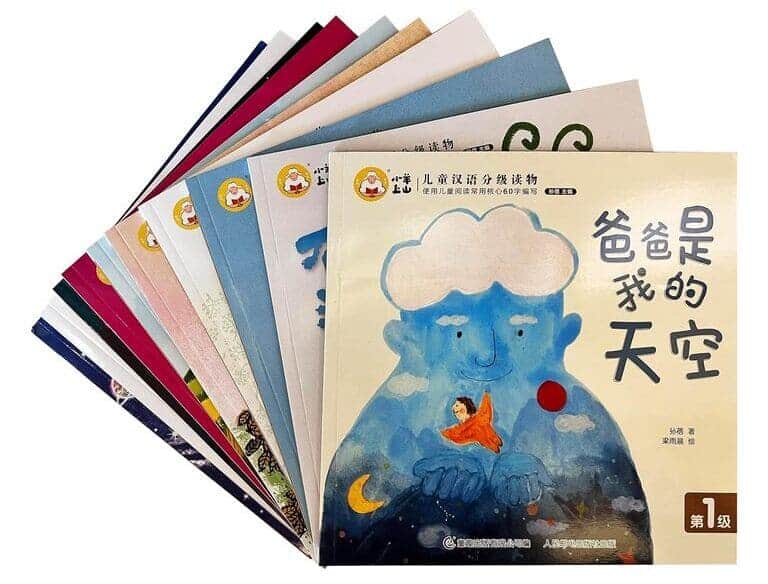
Right for A child who understands Chinese when you speak it but can’t read a word of it. That’s most kids in Chinese-speaking homes — and it’s also where a five-year-old in Beijing starts, which is why the same books work for both.
You’ll need Someone who can read the books aloud. There’s no pinyin and no English, so if you don’t read Chinese yourself you’ll want a reading pen or a Luka robot — Lah Lah Banana, a parent blog that worked through the series book by book, lands on the same conclusion. Cost depends entirely on how you buy it. Ordered direct from China it is by far the cheapest series here, at well under a dollar a book. Bought from an overseas retailer it costs several times that, which puts it in the same range as everything else.
What you’ll see Level 1 teaches its 60 characters rather than assuming them, so a child who knows nothing can open book one and be reading complete stories within weeks — stories, not flashcards. By the end of Level 4 they’ll recognise around 240 characters. Each book ends with a certificate and cut-out flashcards, which matters more than it sounds: kids can watch their own progress stack up.
What to watch for Two places. Around Level 5 the pace changes — the early levels add exactly 60 new characters each, then the increments grow. If reading suddenly feels like a wall there, that’s the series, not your child. The other is cultural: these stories assume a child living in China, so expect a bit more explaining than with books written for families abroad.
四五快读 Sìwǔ Kuàidú
Age 4+ · eight volumes · a method, not a story series
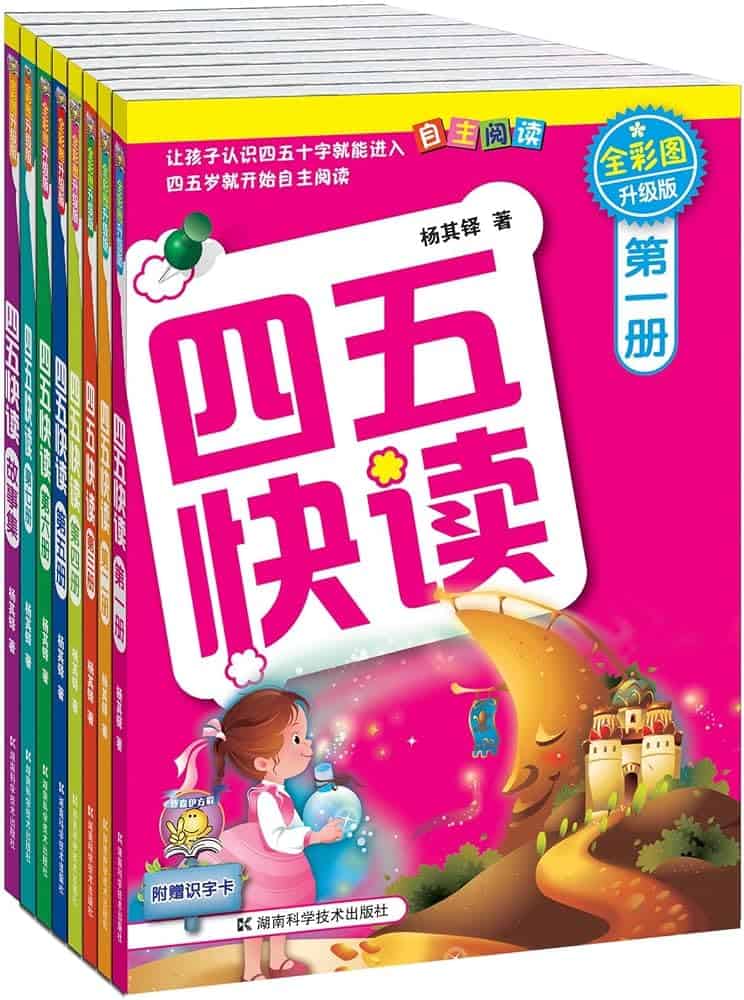
Right for A child who already understands Chinese and needs characters faster. In China it’s sold as a first character book for four- and five-year-olds — but that’s a child who hears Chinese all day. Abroad it does more for a child who has already started reading than for one starting from nothing.
You’ll need An adult who reads Chinese. There’s no pinyin, no writing instruction and no audio at all. Simplified characters only; there’s no traditional edition.
What you’ll see A steady climb from single characters to words, then short sentences, then longer ones. Volume one covers 88 characters across ten lessons. Six volumes introduce new characters and the last two consolidate.
What to watch for It’s drill, and it’s dull in the way flashcards are dull. That’s the trade — it’s the fastest route to a character bank, and it supplies no reason to keep going. Run it alongside a story series rather than on its own.
If your child goes to a weekend Chinese school
《中文》Zhōngwén
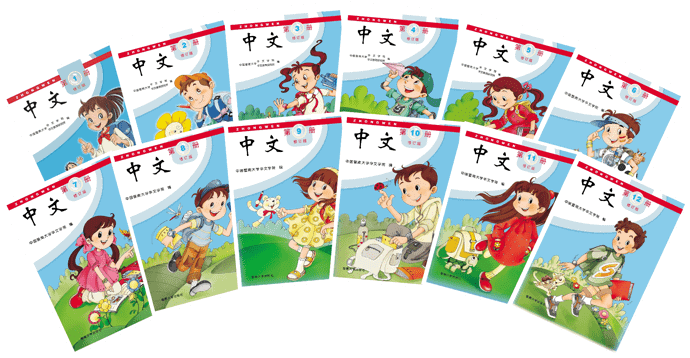
Ages 6–12 · twelve volumes over six years · a curriculum, not a reading series
Right for You don’t really choose this one. Written specifically for heritage primary-school children at weekend Chinese schools in Europe and North America, it’s the default across much of that world — if your child attends one, there’s a good chance it’s already in their bag.
You’ll need A school. In the US it’s distributed only through the Chinese School Association in the United States, and the full system runs to 36 books once you count workbooks. It also needs real weekly time; this is a six-year commitment, not a set of readers.
What you’ll see A complete curriculum rather than reading practice — around 2,500 characters, plus writing and culture, twelve lessons per volume. It’s the only series here that designs pinyin out on purpose: volumes 1 to 4 annotate the full text, and from volume 5 only new characters carry it.
What to watch for Teachers consistently report that difficulty jumps between year levels rather than climbing smoothly, so expect plateaus that aren’t your child’s doing. It’s also not the only option — North American schools also use Ma Liping Chinese and Shuangshuang, both written specifically for kids growing up outside China. If you’re choosing a school, asking which curriculum it uses is a fair question.
If your child is starting with little or no Chinese
七色龙 Qīsè Lóng · Rainbow Dragon
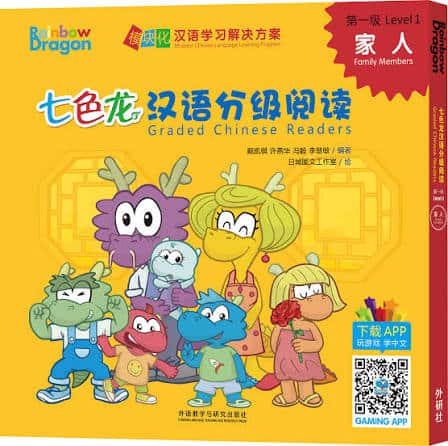
Ages 3-11 · three levels · 225 readers in packs of five
Right for A primary-age child with little or no spoken Chinese, especially one learning at an international or mainstream school. This is the series built for exactly that situation rather than adapted to it.
You’ll need Nothing from you — and that’s what you’re paying for. Pinyin sits on every sentence and there’s a free companion app, so your child can work without a Chinese-reading adult in the room. It’s also the most expensive option here: a five-book pack is ¥128 and a full level is ¥1,920, so start with one pack rather than committing to a level.
What you’ll see Spoken vocabulary, organised by topic — family, food, time, jobs. The stories follow one family of dragons whose names are the simplest characters (天, 山, 水, 火), each with a fixed personality across the series, so children get attached the way they do to the Oxford Reading Tree families. One sentence per page, with pictures worth talking about for a while.
What to watch for It builds words your child can say, not characters they can read. If your child already speaks comfortably and reading is the gap, this series won’t close it — and the price makes that an expensive way to find out.
好朋友 Hǎo péngyou · Friends
Chinese Graded Readers, Youth edition
Teens and up · six levels · mapped to HSK 1–6
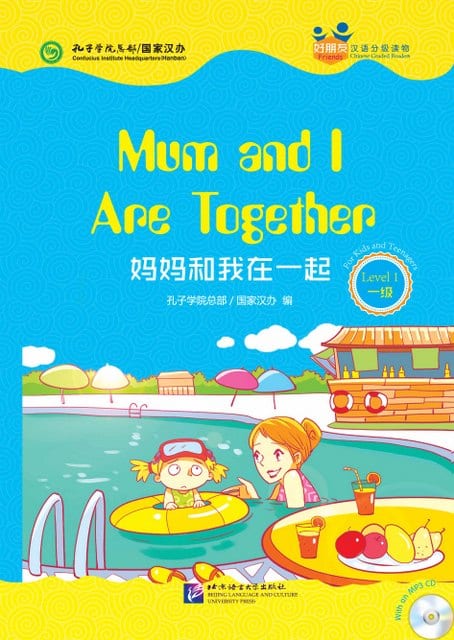
Right for A teenager starting Chinese who would be insulted by picture books. Most graded readers aim at young children, which leaves a real gap for a thirteen-year-old near the beginning — this fills it, and keeps going much further than most.
You’ll need Not much. Words above the current level are glossed in English and the audio is free to download, so it works for self-study as well as alongside a class.
What you’ll see Six levels mapped directly onto HSK 1 through 6, so if your child is working toward the exam you can line the two up. End-of-book exercises follow HSK question types. The stories are original work by non-native learners of Chinese — which is why they need fewer cultural footnotes than most series do.
What to watch for It assumes you’re starting near zero, so a heritage teenager who already speaks well will find the early levels slow.
轻松猫 Qīngsōng māo · Smart Cat
Ages 10–18 · four levels
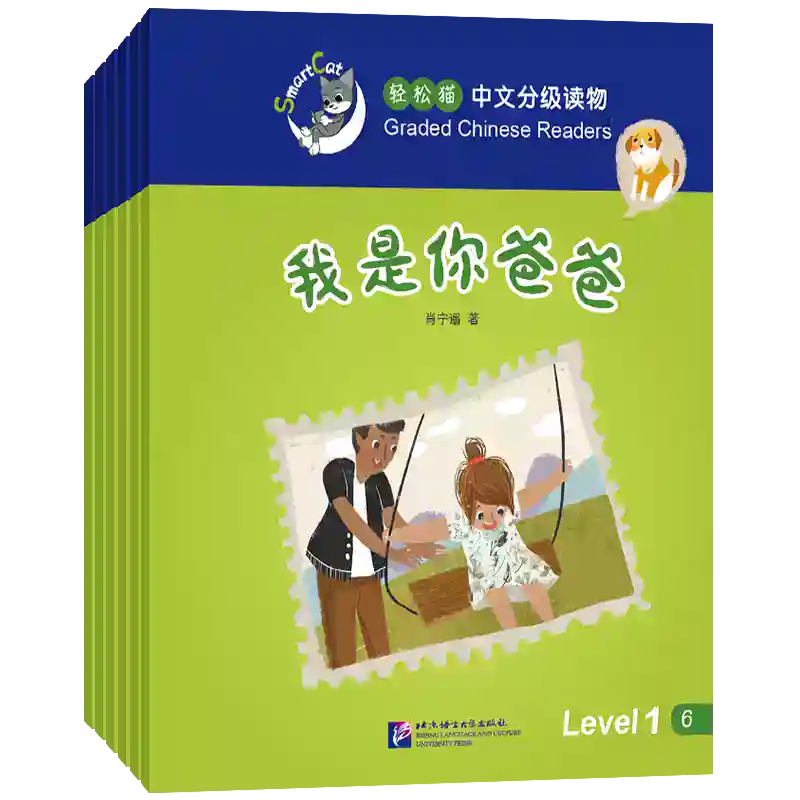
Right for A ten-to-eighteen-year-old who wants stories that aren’t for little kids. The material runs to friendship, first romance and some suspense, written originally rather than adapted down.
You’ll need A phone. Scanning the back cover gives three recordings of every story: a slow clear version, a normal-speed one with a different voice per character, and a live performance version. There’s a resource site with exercises and answers, a vocabulary tool and English versions of the stories, plus a reading guide for every story.
What you’ll see Four levels arranged so vocabulary keeps reappearing rather than showing up once and vanishing. It’s written against the HSK syllabus, so it lines up with exam preparation. Reading is the way in, and the material then pushes out to listening, speaking, writing and performing.
What to watch for Four levels isn’t far. A committed learner will finish and you’ll be looking for what comes next. Like Friends, it assumes a near-zero starting point, so it’s a poor fit for a teen who already speaks.
Do the books need pinyin?
One decision, two cases.
If your child doesn’t speak much Chinese yet, pinyin is how they get in the door. It lets them read well above their character level, and the vocabulary comes faster.
If your child already speaks and reading is the gap, go without. Given both, a child reads the pinyin and skips the character underneath it.
Ma Liping, whose curriculum is used across North American weekend schools, put it plainly back in 1996: pinyin becomes a crutch, and once a child has one it doesn’t get put down. Her own books hold it back until a child recognises about 700 characters.
That’s why the series here split the way they do. It isn’t carelessness on anyone’s part — they’re aimed at different children.
Where to buy these outside China?
Five routes, roughly in order of cost.
1. Chinese e-commerce, shipped out (Taobao, JD). Cheapest by a wide margin and slowest — usually needs a forwarding service. Reviewers ordering 小羊上山 this way report well under a dollar a book. If you’re buying a full level or more, the savings are large enough to be worth the wait.
2. Amazon. All six can generally be found there, but some need the right search term:
- Little Sheep Goes Up the Mountain 小羊上山 – “Graded Chinese Readers” plus the level — searching 小羊上山 mostly returns its companion activity books, not the readers
- Siwukuaidu 四五快读 – 四五快读 (the eight-volume 全彩图升级版 set)
- Zhongwen《中文》– “Jinan University Zhongwen” plus the volume number; sold as textbook + A/B workbook sets
- Rainbow Dragon 七色龙 – Sold as individual five-book theme packs, not as levels
- Friends 好朋友 – “Friends Chinese Graded Readers” or 好朋友汉语分级读物
- Smart Cat 轻松猫 – Individual titles rather than level sets
3. Overseas Chinese bookshops. These carry learner-focused Chinese series specifically, and unlike a marketplace listing, a shop will answer a question about levels before you commit to one. Worth trying: ChinaSprout, Eastern Bookstore and China Books in the US, and zhongwenshu.de in Europe. What each holds changes, so check the current catalogue rather than assuming a particular series is in stock. Expect overseas retail to cost several times the China price. That gap is shipping, import and a shop that will actually talk to you — convenience is what you’re buying, and for a first level it is often worth it.
4. Your child’s weekend Chinese school. The normal route for Zhongwen《中文》, which in the US is distributed only through the Chinese School Association in the United States. Worth asking before you buy anything — schools often supply the curriculum.
5. The library. Some public library systems in North America hold Chinese graded readers, and inter-library loan is worth a call before spending on a full level you aren’t sure about.
Questions parents ask
Want a second opinion before you buy?
We’re happy to look at where your child actually sits and tell you which of these we’d start them with.