The short answer: After five years of Chinese lessons for one hour a week (more than 200 hours in total), Gunnar, now 16, can hold real conversations almost entirely in Chinese. He started from zero, has no Chinese-speaking family at home, and now conducts more than 90% of his GoEast Kids lessons in Chinese.
A Normal Monday
Every Monday, before class even starts, Gunnar is already speaking Chinese with his teacher, chatting as naturally as he would with a friend. Watch it for yourself, then read on for how he got here.
Who Is Gunnar
Gunnar is 16 years old. He started learning Chinese online with GoEast Kids in 2021 with no prior experience — he could say “hello” and introduce himself, and that was about it.
There’s no Chinese spoken at home and no Chinese-speaking relatives. Outside of one hour a week with his teacher, Gunnar has had almost no everyday environment in which to use Chinese. His mother has watched his progress from the sidelines.
Is One Hour a Week Enough? In His Mother’s Words
Gunnar’s mother, who has followed his Chinese learning journey since he started in 2021, put it this way:
“It’s only one hour a week, but every week he’s progressing — he’s not forgetting what he’s learned. We’re very happy with this hour and this consistency.”
— Gunnar’s mother
Asked whether she’d recommend it to a friend, she didn’t hesitate: “Absolutely — the communication has been excellent, and I think you’re doing a great job.” There are several concrete indicators of how his Chinese has changed.
Gunnar’s Chinese Progress, By the Numbers
| Metric | 2021 | 2026 |
|---|---|---|
| Speaking | Basic greetings and self-introduction | Sustains conversations and adds his own reasons and details |
| Classroom language | ~50% English | 90%+ Chinese |
| Listening | One sentence at a time | Full passages |
| Spontaneous speaking | Needed to translate in his head before answering | Often responds without translating first |
What Can He Actually Do Now?
After five years, Gunnar can:
- Hold conversations about familiar topics like school, family, and soccer
- Follow full passages in Chinese, not just single sentences
- Explain his reasoning and opinions, not just give short answers
- Communicate with Chinese-speaking friends at school
Here’s how he built up to that, stage by stage.
Five Years, Four Stages
- Getting started (Fantasy Chinese, Level 1). Fantasy Chinese is GoEast Kids’ story-based curriculum for young learners. Lessons leaned on simple, engaging stories tied to everyday life — family, school, friends, and food. Gunnar would observe details in the story, act out characters, and react to what they did. The goal wasn’t fluency yet, but simply getting him comfortable listening, mimicking, and speaking.
- Building the foundation (progressing through Levels 2–5). Pinyin, listening, and basic conversation became more established, and characters were introduced gradually.
- Moving into real conversation (Easy Steps to Chinese, Levels 2–3). Easy Steps to Chinese is the structured, textbook-based curriculum GoEast Kids uses at the next stage. Real-life topics took over — school, friends, family, and soccer. The questions got harder too, moving from “Where is he? What is he doing?” to “Why did he do that? Do you think that was the right choice? What would you have done?”
- Today. Gunnar doesn’t just answer questions, he adds his own details and reasons without being asked. According to his teacher, none of this happened by accident.
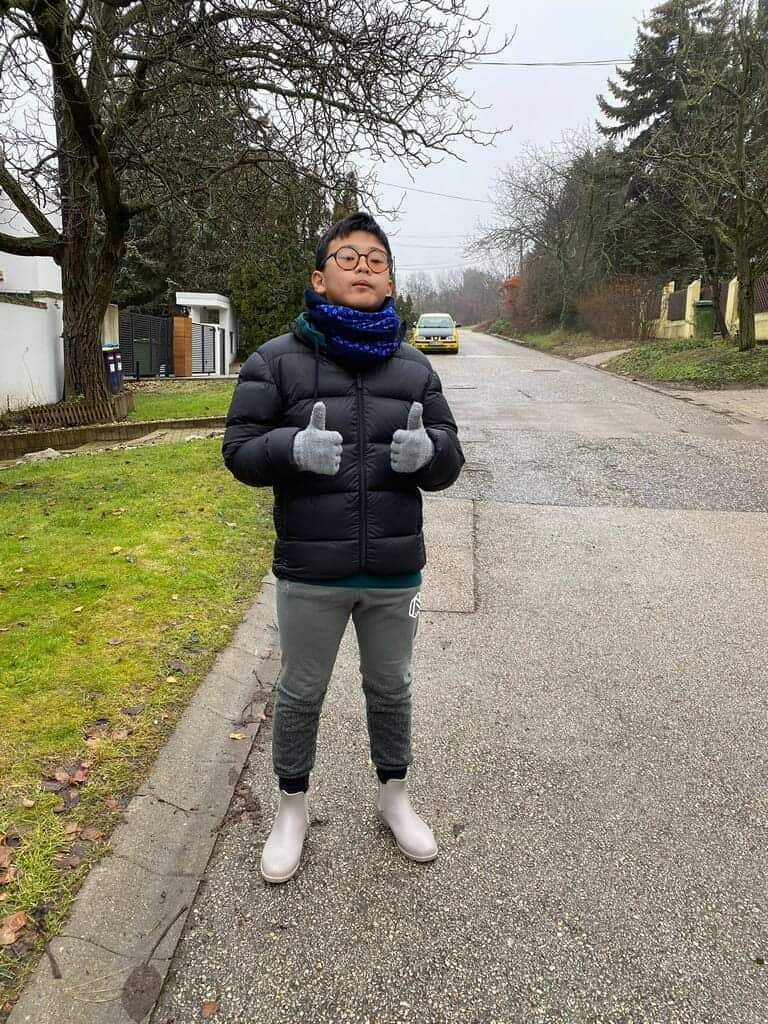
Gunnar in 2021, when he started learning Chinese with GoEast Kids. He could say “hello” and introduce himself, and not much more.

Gunnar in 2026, now 16. After five years of weekly lessons with the same teacher, he holds real conversations in Chinese.
Why His Progress Has Been Steady
Gunnar’s teacher, Dannille Chang (常丹妮), has taught more than 7,200 lessons and helped design GoEast Kids’ own leveling system for K12 Chinese learners overseas. In her view, five things have mattered most for Gunnar specifically.
- The same teacher, the whole way through. Since 2021, Gunnar has learned from one teacher. She knows his interests, his personality, his weak spots — he hasn’t had to repeatedly adapt to a new teacher’s style, expectations, and way of communicating.
Gunnar agrees: “You learn to trust the person, they understand what you need to work on, and you can work together well because of built-up chemistry. Even in my school, my teachers change every year.”
- A curriculum that never skips ahead. Progress moved in careful steps: interest and basic sounds first, then simple dialogue, then characters, and finally real conversation about real life. Each stage builds on the one before it.
- Lessons built around what he actually cares about. Gunnar loves soccer, so class does too — training, matches, teammates, and coaches. Topics he’s not interested in aren’t forced just to drill a word.
- A specific answer to “won’t he just forget it?” Without a Chinese-speaking home, forgetting is the real risk — not learning something new. So old vocabulary keeps resurfacing in new contexts. When Gunnar talks about a soccer match, he’s naturally reusing words for time, place, people, actions, and feelings — “because,” “if,” “why.” He’s not just talking about soccer; he’s practicing everything he’s learned in a context he actually cares about.
- Visible progress that builds its own motivation. The clearest sign of change isn’t how many words he’s learned — it’s that he used to translate Chinese in his head before answering, and his answers came out slow and halting. Now he just speaks it, often adding his own reasons and details without being prompted. That shift, from translating Chinese to actually using it, is what keeps him wanting to continue. Gunnar has his own take on all of this, too.
Learning Chinese as a Beginner: In Gunnar’s Own Words
Gunnar is candid about not finding languages easy. “I remember that I was nervous and unsure,” he says of starting in 2021 — he was learning French at the time, and languages have never come naturally to him. He expected Chinese to be a slog. That’s changed: “It is different now because of my amazing teacher and supporter, Ms. Chang, and I feel very comfortable and able to learn the language.”
Part of why, he says, is that class stays connected to his actual life. “I enjoy talking about things that are happening in my teacher’s or my own life — football tournaments, family plans, what I’m going to do on the weekend,” he explains. “This turns my learning of the language into something practical, to use it in the context of my own life.”
On the moment it clicked: “There was a moment when I realized I can convey beyond just basic conversation, when I spoke with one of my Chinese friends at school… I tried to be creative with Chinese, and use the vocabulary I know to the fullest. And my friend understood everything I said!”
Looking ahead, Gunnar wants to use Chinese in a business context in China. “I love China, and the culture, and I want to go often,” he says — motivation enough, in his own words, to keep learning the language for the smoothest possible experience there.
His advice to another teenager just starting out: “Take your time to get adjusted to the language… Chinese is a skill, like any other skill. Just put some time and patience into it, and you will reap great rewards.” So where does this leave things?
The Honest Answer — And What’s Next
Gunnar’s teacher is upfront about what to expect: with just one hour a week, he isn’t going to sound like a native speaker overnight — that’s not realistic. But his story shows something else clearly: even without a Chinese-speaking home, steady, consistent learning really does add up.
Every child’s pace is different, shaped by factors like age, consistency, lesson quality, motivation, prior language experience, and opportunities to use Chinese outside class.
Curious what this could look like for your child?
Try it free. Start only when you’re ready