Does your child understand Chinese but answer in English? You’re not alone, and it does not mean your child “is not good at Chinese.” Most young children need a reason to speak, not just a request. A simple prop—a puppet that “only understands Chinese,” a toy microphone, a bowl of fruit—can give them that reason, and most need no setup at all.
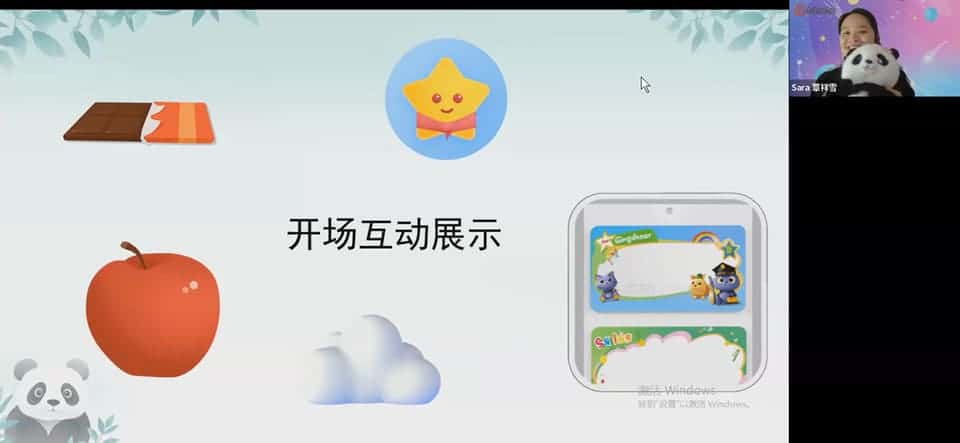
Our teacher Qin Xiangxue (Sarah) recently led an internal workshop for our teaching team on this exact challenge, sharing the classroom techniques she uses to help quiet, hesitant children enjoy speaking. As Sarah put it, a lesson where a child just sits and listens can quickly become “boring” for them.
This guide is for families where at least one parent speaks Chinese at home. Here are the six props our teachers use most, and how to try each one with things you already have.

Why Do Props Work So Well for Young Kids?
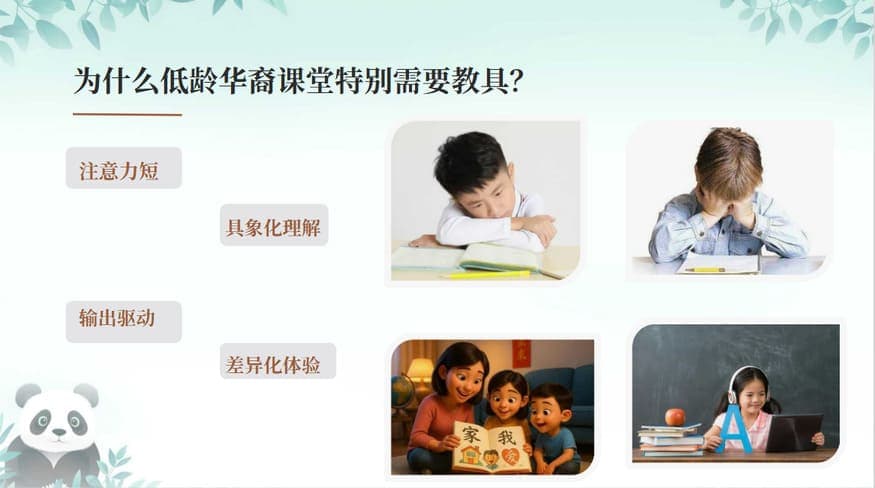
Young children learn differently from older students. They speak when there’s a reason: a game to win, a toy to talk to, a surprise to guess. A prop creates that reason in seconds, keeps a short attention span focused, and gives your child something to see and touch while they talk.
- Short attention spans. A young child can’t stay focused through a long explanation, but they can stay focused on something fun in front of them.
- They learn by seeing and touching. Young children learn best through things they can see and touch.
- Speaking needs a reason. A shy child won’t necessarily speak just because you ask, but they need a scene or a game that makes speaking feel simply natural.
- Every child is different. What gets one child chatting may not work for another, so it helps to have more than one trick up your sleeve.
What Props Do Our Teachers Actually Use?
A puppet that “only understands Chinese”
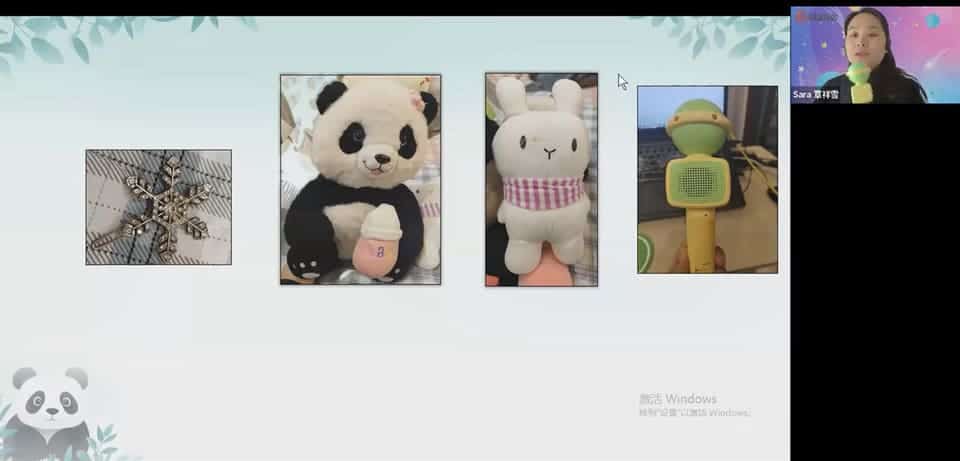
Many of our teachers for young children have a familiar companion that appears in every lesson, such as a puppet or a plush toy. Children come to associate it with their teacher, which builds comfort and trust before the real learning even starts. Sarah described puppets as especially helpful with younger children, and the same idea works when a teacher starts a lesson by talking about something the child loves, so that it feels like “this lesson is about you.”
Try it at home: Pick a stuffed animal to be your “Chinese-speaking friend” who only understands Chinese. Let your child introduce themselves to it, feed it “snacks”, or teach it new words! Many children who won’t answer a parent will happily talk to a toy.
A microphone
For a child who really won’t speak, handing them a microphone (real or toy) can really change everything. Our teachers often pair it with a loud-voice/quiet-voice game, which turns “please say the word” into play.
Try it at home: Any object can be a microphone: a spoon, a rolled-up piece of paper, a toy. Take turns: “Say 苹果 (píngguǒ, apple) in a big voice. Now in a tiny voice.”
Want a teacher who does this every lesson? Our teachers use props like these in their online classes for young children. See our online Chinese classes →
Small rewards
A small prize, sticker, or point for a correct (or even just attempted) answer gives a shy child a low-pressure reason to try.
Try it at home: Keep it tiny and fun: a sticker chart, or a point for every Chinese sentence at dinner. Reward the try, not just the answer.
A little “magic”
When a child starts to zone out, a bit of surprise brings them back. Our teachers use simple magic tricks and a touch of showmanship to win attention back.
Try it at home: You don’t need real magic. Hide a small toy under a cup, wave a scarf, and ask “它在哪里 (Tā zài nǎli? Where it is?)” before you reveal it. Surprise works best when it comes with a question your child can answer in Chinese.
A bowl of fruit
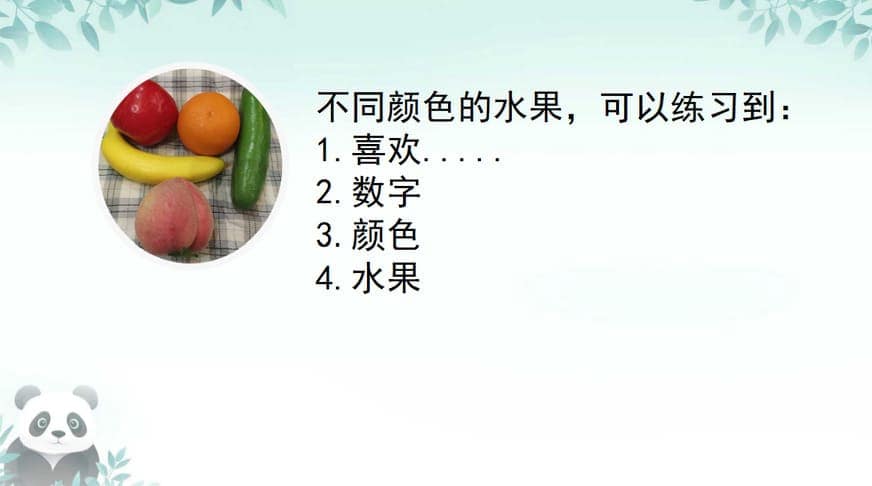
A set of different-coloured fruits is one of Sarah’s favourites, because one object can practise several skills at once: “I like…”, numbers, colours, and fruit vocabulary. There’s no need to switch materials every time the topic changes.
Try it at home: Put a few fruits on the table and ask a string of questions.
Say it in Chinese:
- 这是什么颜色?(Zhè shì shénme yánsè? What color is this?)
- 你看到几个苹果?(Nǐ kàndào jǐ gè píngguǒ? How many apples do you see?)
- 你喜欢香蕉吗?(Nǐ xǐhuan xiāngjiāo ma? Do you like bananas?)
Character cards
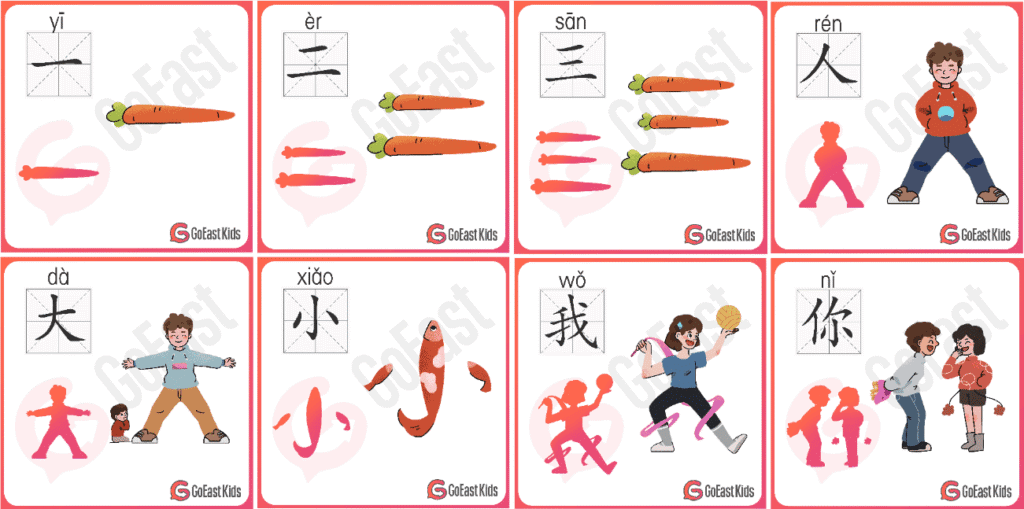
Our lessons for young children focus mostly on listening and speaking, but some parents also want an early start on reading. Our lesson slides include character cards, and some teachers also hold up physical ones. At home, we recommend physical cards: your child can hold them, sort them and race to grab them, so checking what’s sticking feels like a game, not a test.
Try it at home: Make a few cards for characters your child already knows, such as 人 (rén, person), 山 (shān, mountain) or 大 (dà, big). Play “find the card”: say a character and let your child race to pick it out, or hold one up and ask “这是什么字?” Short, playful rounds work best.
How Do I Pick the Right Prop at Home?
You rarely need to buy anything. Decide what you want your child to say first, then pick the simplest object within reach that gets them saying it. A good prop works in seconds and needs no explanation.
Our teachers find props in three places:
- Everyday household objects. Fruit, toys and kitchen items all work for colors, counting and new words.
- Things your child already has. A favorite toy or book can become the prop. It doesn’t need to look “educational.”
- Whatever is within arm’s reach. Pick something up and ask a quick question or two, instead of planning a separate practice session.
When choosing a prop, keep three principles in mind:
- Keep it simple. A good prop works quickly and needs no long setup or explanation.
- Start with the goal. Decide what you want your child to say, then choose the prop.
- Match your child’s level. What suits a beginner may need adjusting for an older or more confident child.
Two things to watch for
- The prop becomes the point. If your child is more interested in the toy than the talking, simplify it or put it away. The fun should serve the language, not replace it.
- The difficulty doesn’t fit. If your child seems bored or lost, the activity probably doesn’t match their level right now. It doesn’t mean they “aren’t good at Chinese.” Make it a little easier or a little harder, and try again.
The Prop Is Just the Bridge
None of this is about the props themselves. As Sarah put it at the end of her workshop, a prop is a bridge: its only job is to make your child want to say something in Chinese. Start with one prop this week, keep rounds short, and celebrate every attempt, even a single word.