

Here’s what most parents don’t realize about helping kids learn Chinese: the single biggest factor isn’t the app you pick, the textbook you buy, or even the teacher you find. It’s consistency. A child who practices a little Chinese every day, even just 15 minutes, will make far more progress than one who does a long session once in a while, then drops it for a month when life gets busy.
One study tracked babies from monolingual homes who received just one hour of daily social interaction in a new language. After 18 weeks, they had developed real bilingual abilities, and their native language kept growing at the same time. You don’t need a perfect plan. You need a sustainable one.
This guide will help you build that plan, step by step, whether your child is 3 or 15, and whether or not you speak any Chinese yourself.
Start with sounds, not characters
This might surprise you: the first thing your child should learn isn’t how to write 你好 (nǐhǎo · hello). It’s how Chinese sounds.
Mandarin is a tonal language, the same syllable can mean four completely different things depending on pitch. The word “妈 mā” means mother; “马 mǎ” means horse. Kids who get early exposure to these tones develop an ear for them that’s very hard to build later. The ability to distinguish unfamiliar speech sounds starts narrowing as early as 12 months in babies who aren’t exposed to them, and continues to decline through childhood.
The good news? You can start building your child’s ear for Chinese right now, at home, no matter what age they are. Here’s what works at each stage:
Ages 3–5: Play, sing, repeat
At this age, the goal is simple: let Chinese become a familiar, happy sound in your child’s world. Not a subject. Not homework.
Try this: pick three Chinese words that fit your daily routine. Say zǎo ān (早安 · good morning) when your child wakes up, chī fàn (吃饭 · time to eat) before meals, and wǎn ān (晚安 · goodnight) at bedtime. Do this every day. Within a week, your child will start repeating them back to you.
Add Chinese nursery songs, even 10 minutes of background music during play time counts. Kids at this age don’t filter languages the way adults do. They absorb tones and rhythms without trying.
That said, a short weekly class with a native-speaking teacher can accelerate things significantly at this age — especially for tones. Young children pick up pronunciation best from real human interaction, not recordings. Our 25-minute classes for 3–5 year olds are built entirely around songs, games, and conversation, so they feel like play, not lessons. See our programs →
Grayson was 4 when he started at GoEast Kids and he was a tough crowd. He struggled to focus, didn’t want to follow along, and showed little interest in participating. His parents also had a specific request: no stars, no points, no reward systems, he gets bored with that kind of repetition. So his teacher tried a different approach. She turned vocabulary into rap — learning the word chī (吃 · eat) through rhythm and movement, so Grayson was singing and dancing before he realized he was learning Chinese. Practice became puzzle challenges with countdown timers instead of repetition drills. Slowly, he started opening up. Today, Grayson puts together full sentences on his own:”wǒ xǐhuān xiǎo māo, wǒ māma yě xǐhuān xiǎo māo” (我喜欢小猫,我妈妈也喜欢小猫。I like cats, my mom likes cats too.)
Ages 6–10: Build on curiosity, add structure
Elementary-age kids thrive when they have a clear learning path and feel personally connected to what they’re learning. That’s why structured classes matter at this age. Kids need a curriculum that builds vocabulary, grammar, and characters in a logical sequence, not random topics week to week.
But structure alone isn’t enough. The magic happens when practice feels relevant. A child who loves dinosaurs will remember kǒnglóng (恐龙 · dinosaur) much faster than a word pulled from a textbook list. That’s why our teachers follow a structured curriculum but bring each child’s interests into the practice, using their favorite topics to create example sentences, role-play scenarios, and conversation exercises.
At this age, kids can handle 25–50 minutes of focused learning and are ready to start connecting sounds to characters. They begin spotting patterns in how characters are built — radicals, stroke order, pictographic origins — and often find it genuinely fun when characters are taught through stories rather than drills.
Pair a weekly class with short daily practice, even five minutes of reviewing what they learned keeps the momentum going.
Ages 11–13: The analytical advantage
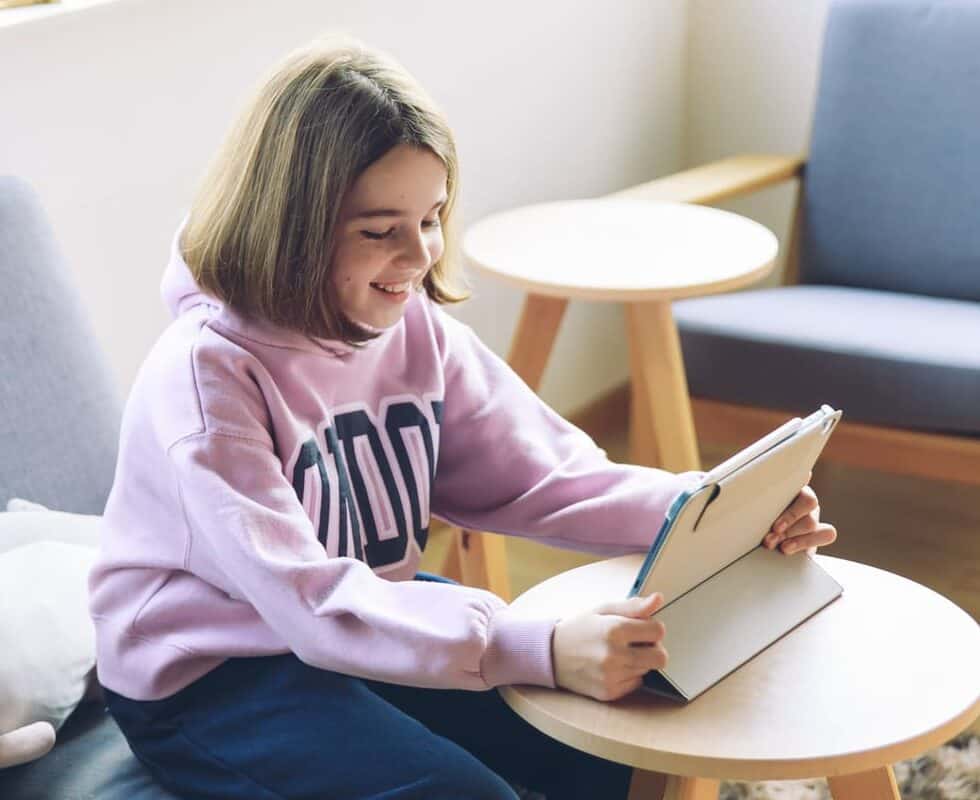
Middle schoolers actually have an edge that younger kids don’t: they can spot patterns and think about language structure. Mandarin grammar is surprisingly simple compared to English — no verb conjugation, no plural forms, no tenses attached to words. When an 11-year-old discovers that Chinese just stacks words in order to build meaning, they often find it satisfying rather than intimidating.
This is also the age where motivation matters most. If your child has a genuine reason to learn — a friend who speaks Chinese, curiosity about Chinese pop culture, a family heritage they want to explore — that internal drive is more powerful than any curriculum.
Ages 14–18: It’s not too late, it’s just different
A lot of parents worry they’ve missed the window. They haven’t. A large-scale study of nearly 670,000 language learners found that the ability to learn grammar stays strong all the way to age 17–18. Teens won’t develop a native accent as easily as a 4-year-old, but they bring serious advantages: self-discipline, the ability to study independently, and crucially their own reasons for wanting to learn.
For heritage Chinese families, the teenage years are often when cultural identity becomes personally meaningful. A 14-year-old who resisted Chinese school as a kid might now want to connect with grandparents, understand song lyrics, or read comments on Douyin. That shift in motivation changes everything.
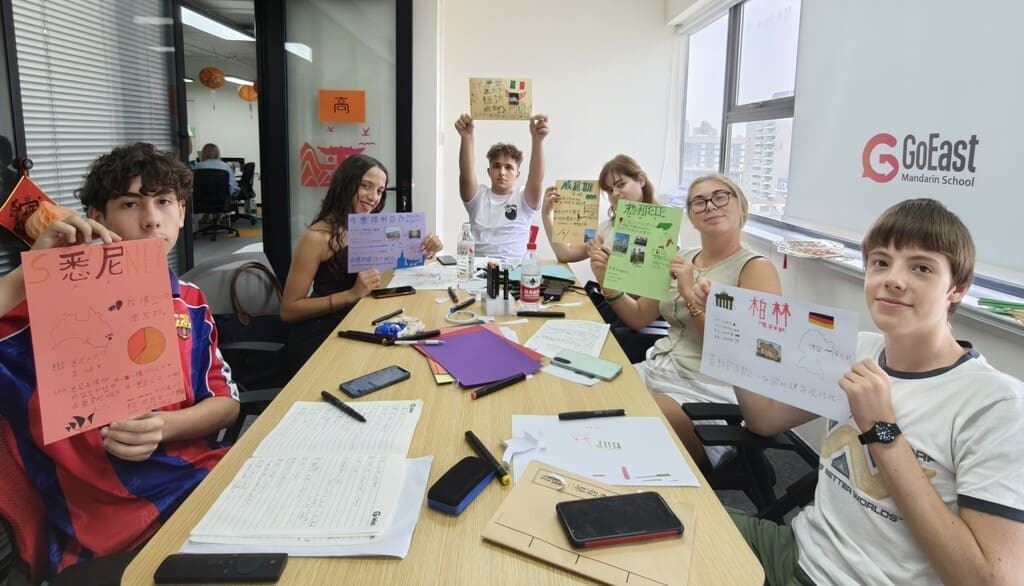
For non-heritage teens, Chinese is increasingly relevant to their interests. Whether that’s gaming communities, study abroad ambitions, or simply standing out on a college application. Our teen classes move at a faster pace and treat students as young adults, not children.
If your teen is looking for an immersive kickstart, our summer camps offer an intensive experience that builds confidence fast.
When to add reading and writing
Here’s a common mistake: starting with character flashcards on day one. Characters aren’t the entry point, they’re the next level.
Wait until your child can understand and say at least 50–100 common words. When they know what shuǐ (水 · water) sounds like and what it means, showing them the character 水 (which looks a bit like flowing water) suddenly clicks. Without that spoken foundation, characters are just abstract shapes with no anchor.
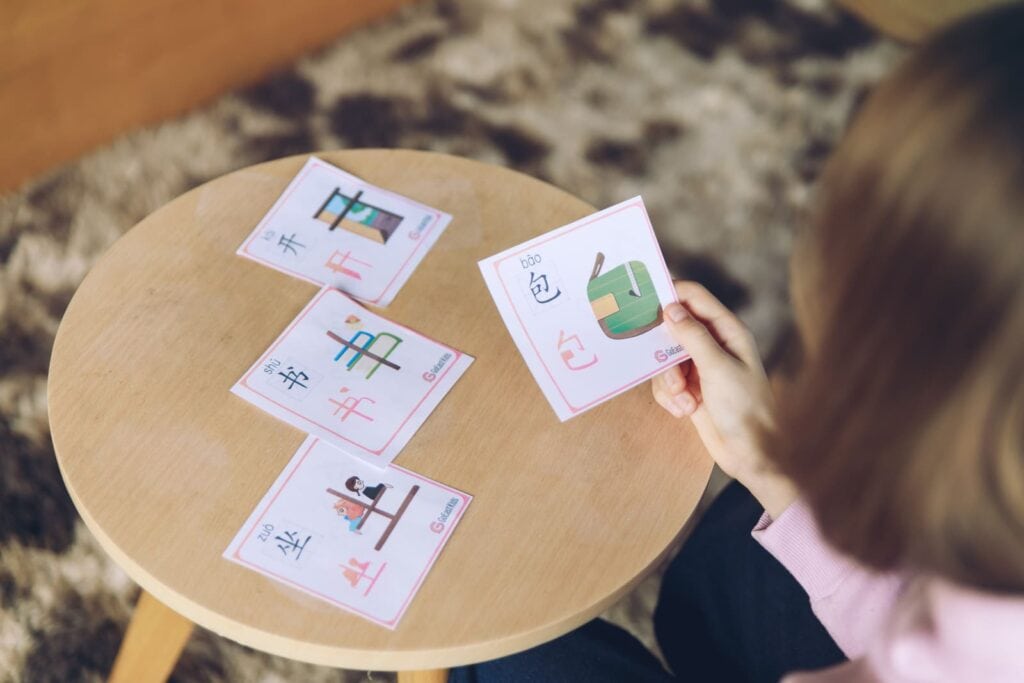
Recognition comes first, writing comes later. For younger kids (roughly 3–6), the goal is simply to see characters and connect them to meaning — through picture books, labels around the house, or matching games. Don’t worry about stroke order or writing practice at this stage. For kids 7 and up who are already comfortable recognizing a set of characters, writing practice becomes more productive, and introducing radicals (the building blocks inside complex characters) helps them decode new characters on their own.
Pick characters that matter to your child, not just the simplest ones. The most common approach is to teach characters from simplest to most complex, but stroke count doesn’t predict how well a child remembers a character. What matters more is whether the character is useful and meaningful right now — a family member’s name, a favorite food, an animal they love. Build a small pool of relevant characters and let your child choose which ones to learn first. Read our full guide to Chinese characters for kids →
One thing to avoid: don’t make writing feel like punishment. “Write this character 20 times” kills motivation faster than anything. Five minutes of relaxed tracing beats thirty minutes of forced repetition.
Resources that actually work
You don’t need ten apps and five YouTube channels. You need two or three tools that you’ll actually use every week. Here’s how to think about it:
For daily exposure at home (free)
Chinese children’s songs and short cartoons are your best friend. Use your child’s daily screen time for Chinese content, or put on Chinese nursery songs during car rides. The goal is regular exposure, not focused study. Even passive listening builds familiarity with tones and rhythm.
Look for content that uses natural, everyday Chinese rather than formal textbook phrases. Stories and songs with repetition work especially well for younger kids.
For active practice (apps)
A good app can reinforce what your child is learning, but no app alone will make your child fluent. Think of apps as the practice between real learning sessions, not the main event.
When choosing an app, think about what your child needs most right now. For beginners, look for apps that prioritize listening and speaking with native speaker audio. For heritage families where kids already speak some Chinese, character-recognition apps can be a great complement to classes. We reviewed the best options for both — see our guide to the best Chinese learning apps for kids →
For real progress (classes with a teacher)
There’s a point where self-study and apps hit a ceiling. That usually happens when:
- Your child needs someone to correct their tones (apps can’t do this well)
- They’ve plateaued on basic vocabulary and need structured progression
- No one in your household speaks Chinese, so there’s no one to practice conversation with
- Your child needs a regular “Chinese time” to stay on track

This is where a live teacher makes the difference. At GoEast Kids, our classes are taught by native Chinese teachers with years of experience teaching children. They know how to keep a 4-year-old engaged and how to challenge a teenager. Classes come in 25-minute or 50-minute formats, and every lesson is designed around conversation and interaction, not lectures. See our programs →
We’ll assess your child’s current level and recommend the right starting point.
“But I don’t speak Chinese…”
Good news: some of our most successful students come from families where no one speaks Chinese. Here’s why it works anyway.
What matters isn’t whether you can teach Chinese yourself. It’s whether you create an environment where Chinese feels normal and valued. You can do that in a few simple ways:
Learn alongside your child. Ask them to teach you one word after every class. Kids love being the expert. And when they see you trying even struggling, they feel less self-conscious about their own mistakes.
Make Chinese visible. Stick labels on things around the house: 门 (mén · door), 冰箱 (bīngxiāng · fridge), 椅子 (yǐzi · chair). Your child will read them without being asked.
Stay involved without hovering. Ask “what did you learn today?” after class. Celebrate small wins: a new word, a correct tone, a sentence they put together on their own.
And in case you’re wondering: no, learning a second language won’t confuse your child or hurt their English. Multiple studies have shown that bilingual children develop their native language at the same rate as monolingual children, and often show advantages in attention and problem-solving.
Harris, 6, lives in Australia. His mom is from Shanghai but the family doesn’t use much Chinese at home. When his dad who is Vietnamese-Australian and doesn’t speak Chinese looked into GoEast Kids for Harris, he had one request: give me materials so I can help him practice after class. They both enrolled at the same time: Harris in the kids program, his dad in GoEast’s adult course. Now, after every lesson, Harris’s teacher sends a recording of the class and designs short homework tasks they can do together — like interview activities where Harris asks his dad questions using the words he just learned. Dad gets to see exactly what was covered, and ends up practicing his own Chinese in the process.
What to realistically expect
Every child learns at their own pace, but with consistent practice — say, one or two classes a week plus 10-15 minutes of daily exposure at home — here’s what you can reasonably expect to see over time, based on what we typically see in our students:
After 3 months: Most children can understand and use some basic everyday Chinese, including simple greetings, self-introductions, and talking about age, family, preferences, as well as numbers and dates. They can also recognize around 20-30 basic characters.
After 6 months: Children can have simple conversations about themselves and daily life, such as talking about family, daily routines, weather, clothes, and favorite things. They can also manage basic exchanges like shopping or asking questions. At this stage, they may recognize around 30-50 common characters.
After 1 year: Chilren can have simple conversations about family and school, talking about classes, transportation, and interests. They can ask about prices and locations and can recognize around 60-100 common characters, Many can read simple sentences and short dialogues.
After 2–3 years: With steady practice, many children can handle most everyday and school situations with relatively little help. They can describe their experiences, plans, and daily routines in more detail, explain reasons, make comparisons, give suggestions, and share their opinions. They may recognize around 120-180 core characters, and be able to read and understand simple stories, short passages, and everyday information.
What does that look like in practice? Gunnar started GoEast Kids at age 11 with zero Chinese, taking just one class per week. His first year was all about building an ear for the language — songs, games, pinyin, and simple conversation. Gradually, the lessons became more advanced: characters came in, topics got more complex, and real-life conversation replaced textbook drills. Now 16, after more than 200 hours of Chinese lessons, Gunnar’s classes are conducted almost entirely in Chinese. Before each lesson, he’ll chat with his teacher about his latest football match or a family trip in Mandarin. He’s had the same teacher since day one, which means the course has grown with him: his teacher knows his interests, his strengths, and exactly when to push him further. Chinese isn’t a subject for Gunnar anymore. It’s how he talks about his life.
Your child’s first Chinese words are one class away
Every child in our classes started exactly where yours is now — with zero Chinese, or a few words, or maybe just a curious parent wondering if this could work.
It can. And the best time to start is before you feel ready.
Not sure what level your child should start at? Our teachers assess every new student during the trial class and recommend the right path. No pressure, no commitment.
Looking for a more intensive experience? Our summer and holiday camps give kids a full immersion week with daily Chinese, cultural activities, and new friends.
FAQ
Sources
- Hartshorne, Tenenbaum & Pinker (2018). A critical period for second language acquisition: Evidence from 2/3 million English speakers. Cognition. Grammar-learning ability preserved until ~17.4 years, then declines steadily.
- Ferjan Ramírez & Kuhl (2017). Bilingual Baby: Foreign Language Intervention in Madrid’s Infant Education Centers. Mind, Brain, and Education / University of Washington I-LABS. One hour of daily social interaction sparked bilingual development in monolingual homes.
- Tsao (2017). Perceptual Improvement of Lexical Tones in Infants: Effects of Tone Language Experience. Frontiers in Psychology. Non-tone-language infants lose sensitivity to lexical tones between 6 and 12 months; Mandarin-learning infants show perceptual improvement.
- Lust & Yang (2009). Learning a second language is good childhood mind medicine. Cornell Chronicle / Cornell Language Acquisition Lab. Bilingualism does not cause language confusion or delay; bilingual children show stronger attention control.