What makes a Chinese class fun and interactive for kids? Games, colorful slides and a lively screen can help, but what decides a lesson is how much the child is listening, thinking, answering, getting things wrong and trying again.
To show you what that looks like in practice, here are two real GoEast Kids lessons taught by our teachers. The students differ in age and level, and the two lessons look nothing alike — but the same five teaching decisions run through both.
Five Teaching Decisions You Can See in These Lessons
1. Let the child finish the sentences.
A common way to teach a new word is to introduce it, have the student repeat it, and move on. That can be useful—but it doesn’t tell us whether the child can actually use the language independently. In our lessons, teachers look for opportunities for students to complete their own thoughts. For example, if a student knows the word but cannot yet put it into a sentence, the teacher may give them part of the sentence and let them work out the rest. Just like our teacher Tina does when Yuling forgets 篮球 lánqiú (basketball), gives it to her, and then asks: 我们用句子说。这是什么? Say it in a sentence. What is this?
2. Use questions to help children correct themselves
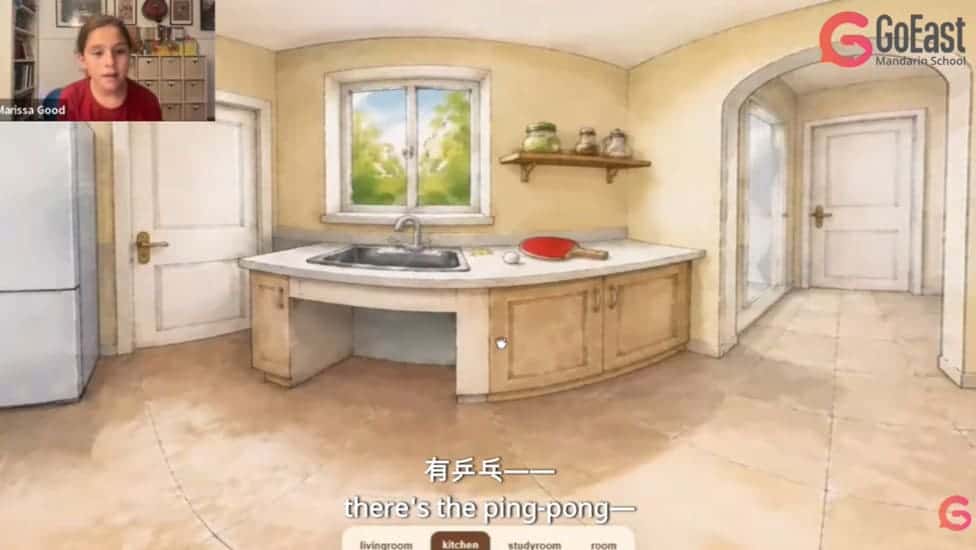
When a child gets something wrong, our teachers ask a smaller question instead of supplying the correct word. In a lesson with a nine-year-old, the student is talking about table tennis and uses the wrong verb, 踢 tī (to kick). Instead of correcting her, Tina holds up her own hands and asks: 用手应该怎么说呢? With your hands, how do we say it? Seven seconds later the girl has it herself: 打乒乓球 dǎ pīngpāngqiú (playing ping-pong). The mistake is fixed, and the child is the one who fixed it.
3. Connect the language to the child’s own life
Children have much more reason to use language when it is connected to something they actually care about. What they like, what they did, what they would do. That’s where the language stops being homework, and the child has a reason to say it.
This is one reason our teachers don’t always treat the lesson plan as a script that has to be followed word for word. A carefully designed activity provides a structure, but the student’s answers can create new directions for the conversation.
4. Make the activity require Chinese
An activity only counts as a language activity when it cannot be completed without the target Chinese. A blind box challenge with no required structure would be a very enjoyable hour in English. Naming the pattern on the task card — use 为了……而…… (in order to …, …) in your answer — is what keeps it a Chinese lesson. This is also the practical test for parents: not which class has the most games, but which games cannot be won without the language.
5. Let the level set the task, not simply the age
Two children of the same age can sit at completely different levels, so the task follows the level rather than the birthday. A lower-level learner may need more visual support and shorter speaking tasks. A more advanced learner may be ready to explain an opinion, tell a story, or solve a more complicated problem in Chinese. Good teaching adapts the challenge without taking away the child’s opportunity to think and speak for themselves.
Lesson 1: How 3D VR Helps a 9-Year-Old Move from Single Words to Full Sentences
The judges’ verdict: Clever VR design let students hunt words in a 3D house, held tight throughout.
Class format: online 1-on-1
Lesson length: 50 minutes
Frequency: 1-2 lessons per week
Student age: 9
Level: intermediate picture-book level
Teacher: Tina Yang
Yuling is nine and sits at intermediate picture-book level. She understands and says individual words, and is still working toward putting them into full sentences on her own. Tina’s design goes at that gap in three moves.
The VR has a job. All five target words are about rooms and objects: 走来走去 zǒu lái zǒu qù (pacing back and forth), 打乒乓球 dǎ pīngpāngqiú (playing ping-pong), 洗碗 xǐ wǎn (washing dishes), 下棋 xià qí (playing chess) and 看电视 kàn diànshì (watching TV). So teacher Tina, with course design by Kiera, rebuilt the picture book’s living room, kitchen and study as a 3D house and gave Yuling a reason to walk through it: the boy can’t find a ball and a bowl, and she has to. The words end up attached to rooms she searches, not to a list she reads.
Nothing stays a single word. Every time Yuling produces one word, the teacher asks for it back in a sentence. She forgets how to say basketball, so the teacher gives her 篮球 lánqiú, then refuses to stop there: 我们用句子说。这是什么? Say it in a sentence. What is this? 这是篮球, this is a basketball.
The last three minutes leave the book. The story was built around two patterns, 我能和你……吗 wǒ néng hé nǐ … ma (can I … with you?) and 现在不行 xiànzài bù xíng (not right now). Instead of drilling them, the teacher turns to Yuling herself, and then, at the very end, puts the pattern back into her life: 下次如果有人找你,你有事情在忙,你要怎么说? Next time someone asks you for something and you’re busy, what do you say?
Lesson 2: Turning a Game Into Real Chinese Conversation
The judges’ verdict: A blind box question game turned target vocabulary into expression students competed for.
Class format: onsite group (GoEast Kids summer camp in Shanghai)
Lesson length: 50 minutes
Frequency: 3 lessons per day
Student age: 11-15
Level: upper-intermediate
Teacher: Cici Huang
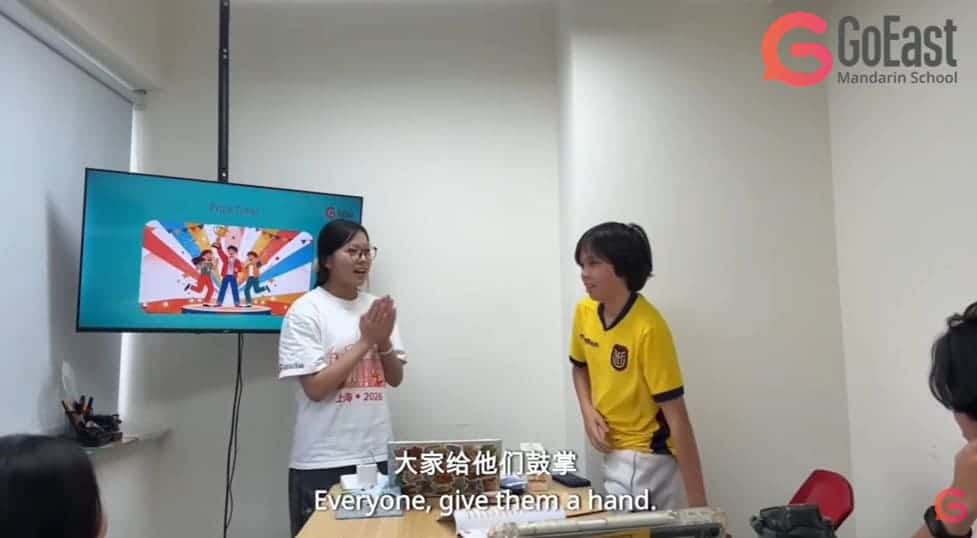
The second lesson involved three students aged 11–15, upper-intermediate, already able to speak in paragraphs and give an opinion in Chinese. This one is an in-person group class: our online Chinese lessons are one-on-one, and the small-group format is what our Shanghai camps are for. Lesson designer Cynthia built the hour around blind box culture—a topic familiar and interesting to many children and teenagers. The activity created situations where students had to use Chinese to express what they thought, make choices, and respond to questions.
The game makes them want the turn. Nine real blind boxes sit on the table, sorted into 普通款 (regular), 热门款 (popular) and 隐藏款 (hidden). Each one holds a speaking task; the rarer the tier, the harder the task and the higher the points. Students pick their own box, and the top scorer chooses first from the real blind box prizes at the end. The scoring turns into pressure the students put on themselves and becomes a reason for them to speak Chinese.
Every task names the Chinese you have to use. This is what keeps it a lesson. Pull a regular style and the card names the structure: 为了……而…… wèile … ér … (in order to …, …). Then the question: why do so many people buy blind boxes over and over? The answer that scores is 为了抽到隐藏款而反复购买, they keep buying in order to pull a hidden style.
By the end that requirement is doing real work. Asked why popular series go up in price, Zihe builds the causal chain himself: 价格会上涨,因为……数量不多,很多人想买, the price goes up, because … there aren’t many, lots of people want them. Supply and demand, reasoned out loud, in a second language, by a teenager.
What These Two Lessons Have in Common
The students are different: one is 9 years old, the others are teenagers. The topics and activities are different, but the underlying teaching decisions are similar.
| What you see | What the teacher is trying to achieve |
|---|---|
| The child answers instead of simply repeating | Independent language production |
| The teacher asks a smaller follow-up question | Guided self-correction |
| The lesson connects to familiar interests | Meaningful language use |
| The activity requires Chinese | More opportunities to speak |
| The task changes with the learner’s level | Appropriate challenge |
None of these techniques requires a lesson to be complicated. What matters is the teacher’s ability to notice what is happening in the moment and respond accordingly.
From Teaching Skills to the Classroom
These two lessons were part of our Teaching Skills Competition (August 2026), where our Kids & Teens teaching teams received first and second place.
For us, the value of the competition was not simply the result. It gave our teachers an opportunity to examine their own teaching closely: how they designed activities, how they responded to students, and how they created opportunities for children to use Chinese.
Those are the same skills we want to see in everyday lessons.
More on how we teach: our teaching approach.
Find out whether our Chinese class fits your child
Book a free 25-minute trial. Your child does a real lesson with a teacher, and you get a written first-class report afterwards: where they sit on listening, speaking, reading and writing, and what the first stretch should focus on.